

Replacing Missing Teeth
Dental Implants Presentation
To provide you with a better understanding of dental implants, we have provided the following multimedia presentation. Many common questions pertaining to dental implants are discussed.

Tooth Replacement Options
You can select from a number of different options to replace your missing teeth – from temporary to long-lasting solutions.
A good candidate is anyone missing one or more teeth, or who is unhappy with their dentures. Age is not a factor. However, smoking, diseases such as diabetes, and radiation therapy to the area, have been shown to lower the success rate of implant placement. X-rays of your jaw will be taken to evaluate whether they will accommodate implants. Detailed x-rays may also be required to determine if other tests or procedures are needed to place implants properly.
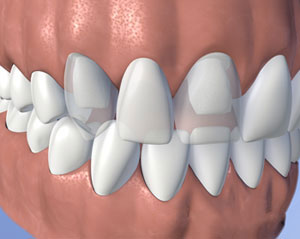
Fixed Bridge
A fixed bridge is a connected set of replacement teeth. For support, it is cemented into position on top of the teeth adjacent to the empty space. The protective outer layer of these teeth is usually removed or ground down prior to attaching the bridge.
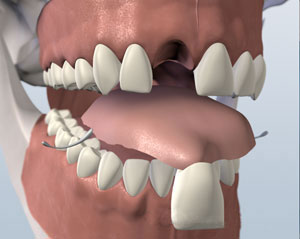
Flipper
A fragile, temporary and inexpensive solution is a removable plastic tooth with a plastic retainer, often called a “flipper”.
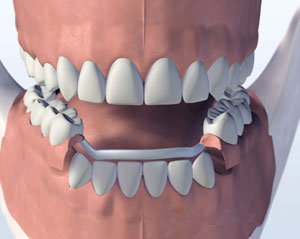
Metal Partial
A less fragile option is a removable partial denture cast in metal and plastic. It is held in place by wire clips. A removable partial denture can be removed and reinserted when required by the patient.
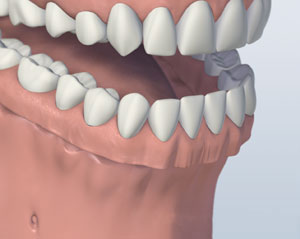
Denture
The most common solution, for people missing all teeth in one or both jaws are complete dentures. Some people adapt well to dentures. Others find them uncomfortable, even intolerable, because of differences in jaw size and shape.
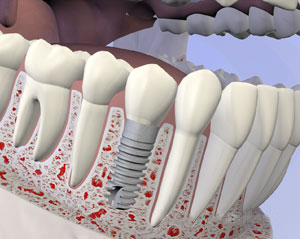
Dental Implants
Dental implants are the most comfortable and permanent solution. They form a strong foundation for teeth and keep the jaw healthy and strong. Implants support individual replacement teeth or secure specialized dentures in place. Unlike bridges, no healthy teeth are damaged. Unlike most bridges, implants can last a lifetime. Implant-supported replacement teeth can be attractive, stable, and comfortable for almost any patient.
Why Select Dental Implants Over More Traditional Types Of Restorations?
There are several reasons: A dental bridge can sacrifice the structure of surrounding good teeth to bridge the space of the missing tooth/teeth. In addition, removing a denture or a “partial” at night may be inconvenient, not to mention dentures that slip can be uncomfortable and rather embarrassing.
How long will the implants last?
Implants usually last a long time. When patients are missing all of their teeth, long-term studies (more than 30 years) show an 80 to 90 percent success rate. For patients missing one or several teeth, recent studies show a success rate of greater than 95 percent, which compares favorably with other areas in the body that receive implant replacement (such as hips or knees). However, if one of your dental implants either doesn’t heal properly or loosens after a period of time, you may need to have it removed. After the site heals (or on occasion at the time of removal), another implant usually can be placed.