
WHAT IS BONE GRAFTING?
Over a period of time, the jaw bone associated with missing teeth atrophies and is reabsorbed. This often leaves a condition in which there is a decrease in quality and quantity of bone. This is not suitable for the placement of dental implants.
With advanced bone grafting techniques we now have the opportunity to not only replace bone where it is missing, but we also have the ability to promote new bone growth in that location. This not only gives us the ability to place implants of proper size, it also gives us a chance to restore functionality with a cosmetic appearance.
Missing teeth over a period of time can cause your jaw bone to resorb and if enough teeth are missing, then undergo a process known as “atrophy”. This often results in a decreased quantity of bone which would otherwise be required for the placement of dental implants.
Dr. Stanford has advanced training in bone grafting and guide bone regeneration surgical techniques, resulting in the ability to transfer bone to where it is needed. This allows you to have implants of proper size, and a chance to restore functionality with a cosmetic appearance.
TYPES OF BONE GRAFTS
Autogenous Bone Grafts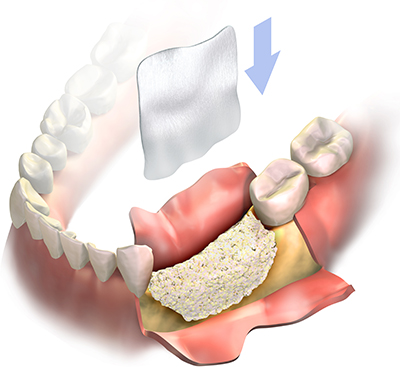
Autogenous bone grafts, also known as autografts, are made of your own bone, taken from somewhere else in the body. The bone is typically harvested from the chin, jaw, lower leg bone, hip, or the skull. Autogenous bone grafts are advantageous in that the graft material is your own live bone, meaning it contains living cellular elements that enhances bone growth (“osteoinductive”). There is also a decreased risk of your body having a reaction to the graft material since it comes from you.
However, one downside to the autograft is that it requires a second procedure site to harvest bone from elsewhere in the body.
Allogenic Bone
Allogenic bone, or allograft, is a donor bone harvested from a human cadaver, which is then processed using a proprietary technique. Unlike autogenous bone, allogenic bone cannot produce new bone on its own. Rather, it serves as a framework, or scaffold, over which bone from the surrounding bony walls can grow to fill the defect or void. Allogenic bone is “osteoconductive”.
Xenogenic Bone
Xenogenic bone, or xenograft, is derived from non-living bone of another species, usually bovine or porcine. The bone is processed via a proprietary technique to avoid the potential for immune rejection and contamination. Similar to allogenic grafts, xenografts are “osteoconductive” and serve as a framework for bone from the surrounding area to grow and fill the void.
Both allogenic and xenogenic bone grafts have an advantage of not requiring a second surgical site to harvest your own bone, as with autografts. These two options of bone grafting do not have the ability to signal and stimulate new bone growth. Bony healing with allografts or xenografts will occur via a process or bony replacement.
Synthetic materials also have the advantage of not requiring a second procedure to harvest bone, reducing risk and pain. Each bone grafting option has its own risks and benefits. Dr. Stanford will determine which type of bone graft material best suited to your particular needs.