

Overview of Implant Placement
WHEN CAN DENTAL IMPLANTS BE PLACED?
Implants can either be placed at time of extraction or at a later date after the tissue and bone have had time to heal. In certain instances, implants can be placed at the time of extraction (“immediate”) if there is enough supporting bone and no signs of infection or pathology. Implants can also be placed several weeks or months after extraction depending if there is a need for keratinized tissue. In some instances, bone grafting procedures may be required if there is inadequate bone at the planned implant site.
In many instances the tooth may have been missing for several months-years. In this instance, the adjacent supporting bone is likely to have resorbed, resulting in a bony defect at the planned implant site. This resorption occurs because the previous tooth root simulates the alveolar (“jaw”) bone growth. Once the tooth root is removed, the alveolar bone begins to deteriorate. If there is not enough bone at the planned implant site, you may benefit from having additional bone grafted into the area. This will ensure the implant will be adequately supported when it is placed in the jaw.
HOW MANY IMPLANTS DO I NEED?
Commonly, a single dental implant is placed to replace a single missing tooth. If two or more teeth are missing, then multiple implants may be indicated to allow for a fixed bridge to be attached. If you are missing all of your teeth from the top jaw (maxilla) then a minimum of 4-6 implants will be required to replace the teeth of the top jaw. If you are missing all of the teeth from the lower jaw (mandible), then a minimum of 2 implants will be required to retain your denture (i.e. implant retained denture). Many patients benefit greatly from this option as it improves denture retention and stability and improves your ability to chew and bite into food. The bone of your mandible (lower jaw) is much denser than your maxilla (top jaw) which is the reason less implants may be indicated on the lower jaw. Dr. Stanford will discuss these options with you and if you are a candidate for dental implants.
How long does the dental implant planning and surgery take?
The number of appointments and time required, vary from patient to patient. Prior to your implant surgery, you will have an evaluation with Dr. Stanford to determine your treatment options. You will have 3D imaging obtained at your initial appointment. In many instances, you will not need to have “old fashion impressions” obtained. Dr. Stanford has state of the art intraoral scanning technology to capture a 3D rendering or your oral cavity. The information obtained from the 3D imaging will be combined into a virtual implant planning software for virtual planning of your surgery. All of this information is obtained to maximize surgical precision by utilizing CT guidance.
Depending on the complexity of the case and the number of implants placed will determine the length of surgery. In general, implant placement is a relatively quick surgical procedure and takes less than 1 hour for a single implant and may take a couple of hours for more complex cases involving multiple implants. For your comfort, implant surgery can be performed under local anesthesia or sedation.
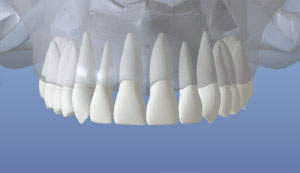
1. Normal
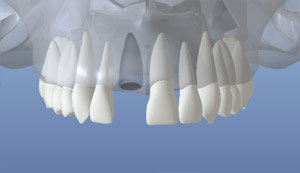
2. Tooth Loss
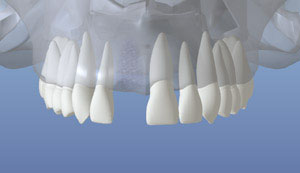
3. Healed Bone
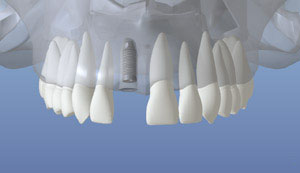
4. Implant Placed
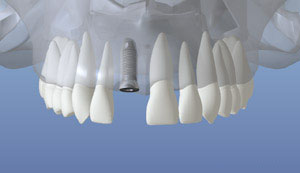
5. Healing
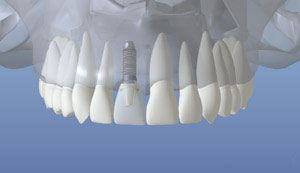
6. Implant Restored
How long does it take the implant to heal?
Dr. Stanford uses an advanced implant system which results in faster healing times for you. The implants placed at Cypress Bend Oral and Maxillofacial Surgery can be completely healed within 8 weeks for the large majority of cases. This process is called “osseointegration”. This process results in your bone actually growing into and fusing with the implant. The length of time varies from person to person, depending upon the quality and quantity of bone. However, in instances of poor bone quality or impaired healing, your healing period could be as long as 4 months to obtain osseointegration. Osseointegration is determined by a radio frequency device that Dr. Stanford will measure at time of placement and at specific intervals to determine your specific healing trend.
At the time of placement, Dr. Stanford will either place a healing abutment or cover screw depending on your specific scenario. As mentioned previously, the majority of cases require 8-12 weeks of healing to allow for proper bone and soft tissue healing and maturity.
Depending on the arrangement with your restorative dentist, Dr. Stanford has the ability to obtain digital impressions at this time. This enables the crown to be ready at the next appointment that you have with your restorative dentist.
What to expect after implant surgery?
In general, post-operative discomfort is minimal. You can expect a slight discomfort and swelling for a few days after surgery. You will be given post-operative instruction the day of your surgery. As stated above, in order to obtain osseointegration of the implant with your jaw bone and healing/maturity of the soft tissue, it will take 8-12 weeks.
HOW LONG DO DENTAL IMPLANTS LAST?
In general, implant 20-year survival rate is near 95%, and 5-10 year survival rate near 98%. Remember that implants will require periodic cleaning and maintenance, by your dentist, similar to natural teeth. Failure to have routine dental implant maintenance can result in development of inflammation and bone loss around the implant eventually leading to failure of the implant.
Dental Implants Presentation
To provide you with a better understanding of dental implants, we have provided the following multimedia presentation. Many common questions pertaining to dental implants are discussed.